{Shikoku Hachijūhachikasho Meguri}
--WALKING--
--TEMPLE PROCEDURES--
--WALKING--
--TEMPLE PROCEDURES--
After arriving at a temple there are five stops that you need to make if you want to do the pilgrimage "by the book." The stops are:
|
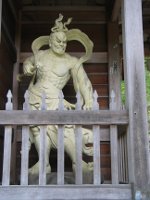
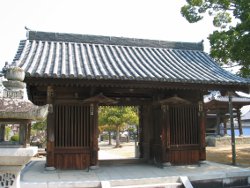
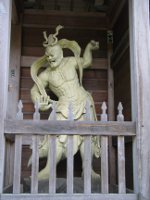 To enter all but a few of the temple compounds you must pass through a gate and this is where you make the transition from the secular world to the sacred. The most common type is called the Niōmon and on each side is an enclosure housing a Niō guardian deity. These deities protect the temple from evil so many henro stop and make an offering to each of them. This is usually a ¥1, ¥5, or ¥10 coin, or a pinch of uncooked rice. If there are no Niō deities, then the gate is called the Sanmon (Mountain Gate).
You might see small straw sandals tied to the Niōmon at some of the temples. While i've never seen anyone actually do it, some 'traditional' henro make an offering of these at the Niōmon. The sandals symbolize both strong feet and a safe journey so by making an offering of them the henro is praying that both will be granted. You may also see very large, 6 feet (180cm) tall sandals, but those were put there by the temple itself, for the same reason.
|
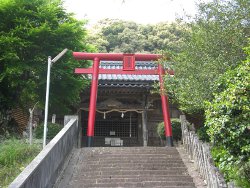
Time out for a note: Just in case you aren't already familiar with the difference between Shintō shrines and Buddhist temples, here is your handy guide. | ||
 |
 |
|
| If you see a sanmon or niōmon like this you are entering a Buddhist temple. | If you see a torii like this you are entering a Shintō shrine. | |
|
Understand, though, that because Buddhism and Shintō shared compounds through most of Japan's history (up to the Meiji Era), a few temples today still have a torii left over in their compound. But, even if there is a torii in the compound, to enter a temple you will always go through a sanmon or niōmon first. | ||
OK, back to where we left off... Once you arrive at the temple, stop just in front of the gate, offer a slight bow, or at least a bow of the head, then pass through.
At many temples you have to climb a set of stairs to get from the gate to the temple itself. The steps are usually made of stone so are called ishidan. In most cases the number of steps aren't important but in some cases it is significant. In these cases the steps may represent either yakudoshi or bonnō.
Yakudoshi are the ages that are considered as being especially dangerous for us. The age is different for men and women but when one reaches one of the dangerous years it is thought that you are vulnerable to sickness, business or personal faliure, other misfortunes, and even death. While the list of dangerous years is quite long (see Temple 23 information), the most dangerous year for men is 42 and for women is 33. Therefore you will see stairs that have that number of steps in them. For example, one side of the stairs going up to Temple 23 has 42 steps and men climb this side. 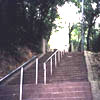 On the other side of the stairs there are 33 steps and this is the side that women climb. If you are at the appropriate age, as you climb the appropriate steps it is traditional to place a ¥1 or ¥5 coin on each of the steps as an offering to the deities.
Bonnō stairs, on the other hand, represent the 108 worldly desires that Buddhists believe all humans are afflicted with no matter your age. At these temples there are 108 steps to climb but it is not necessary to place coins on each of the steps. Just by climbing the stairs, you symbolically eliminate one of the desires for each step you climb.
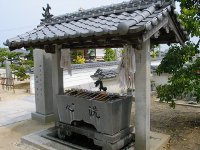 At the top of the stairs, or just inside the gate in the case of no stairs, you will see a small covered stand with water (chōzubachi or temizuya), water ladles, and (usually) hand towels. Wash your hands and rinse out your mouth to purify yourself before entering the temple compound. Instead of looking at this as an actual washing, think of it as more of a rinsing to remove the dust of the secular world. Don't wash your hands in the water; use a ladle to pour water over your hands outside of the water basin. That's IMPORTANT. Outside the basin. You are rinsing off the impurities of the secular world. If you let the water go back inside the water basin, you are contaminating the water that everyone else also needs to use. Also, don't drink from the ladle; pour a little water into your now cleaned hands and sip from your palm.
More specifically:
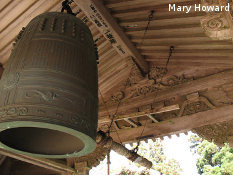 After leaving the ablution basin, traditional henro stop at the belfry (shōrō) and ring the bell to let the temple's deities know that they have arrived. Note that some temples have the striker tied up so that you can't ring it; apparently, it annoys the neighbors. If it is possible to ring the bell, be sure to do it when you enter the compound and not when you leave. Ringing the bell as you leave may shatter and spoil any enlightenment experience you might have had while at the temple.
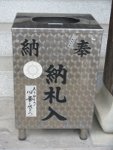 Now proceed to the Hondō. Begin by putting an osamefuda (name card, and usually just called an Ofuda) in the box to the right or left of the temple door at the top of the stairs. The simplest Ofuda are slips of paper about 2" wide by 5" long (5 cm x 13 cm) with space to write your name, address, and the date on them. In addition they will have a stamped image of Kōbō Daishi and the words Hōnō Hachijūhachi Reijō Junpai. Dōgyō Ninin (An Offering. 88 Sacred Sites Pilgrimage. We Two, Traveling Together). Some Ofuda may have the words Namu Daishi Henjō Kongō written on them. The more elaborate Ofuda will have the same information, but be slightly larger in size. In all cases, though, their purpose is both to identify yourself to the Daishi and the deity of the temple and to memorialize your visit there. (Here's how to fill one out). If you have a special wish for the deity, write it on the sides or back of Ofuda.
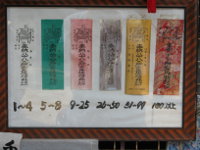
While the vast majority of the ofuda you will see are simply white and made of paper, they come in different colors and it is the color that signifies how many pilgrimages the henro has undertaken. According to the books i've read, the color scheme is:
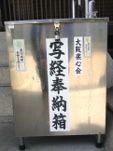 Some people leave handwritten copies of the Heart Sutra (called shakyō) at every Hondō and Daishidō of every temple. These are copies that they have either hand written before starting the pilgrimage or that they write the night before they get to a temple. They go in a special box, also located at the top of the stairs and to the left or right of the temple door. They look very similar to the box for your osamefuda but it is easy to tell the two boxes apart, even if you can't read the kanji written on them. Notice the metal boxes in the two pictures on the left. The entire surface of the box for the Heart Sutra will be completely smooth. The box for your Ofuda will not be; the entire surface has a pattern in it.
Next, go back down the stairs and put a lighted candle in the glass-enclosed, frequently orange or red colored, candle holder (rōsokutate) as an offering to the Buddha, Kōbō Daishi, and the dead. Then offer 3 sticks of incense (in one bundle) in the appropriate sand-filled container (kōro) to venerate the deities and the dead.
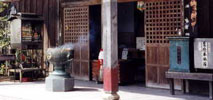
In the image to the right, the candle holder is the glass & silver box on 3' (1 m) legs at the far left. The incense burner is in the center with the smoke rising above it. The box for Ofuda is the silver box on the far right.
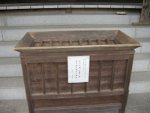 Finally, go back to the top of the stairs and throw a few small coins in the offertory box immediately in front of, or inside, the temple door. It used to be that the offering was typically between ¥10 and ¥100, but now it seems that any donation starting at ¥1 is acceptable. In addition some people leave other objects symbolizing a special prayer that they have brought to the temple's deity. It is also quite common for people to leave pictures of people for which they have brought special prayers.
If it is crowded, stand off to the side or go back to the bottom of the steps so you are out of the way. Otherwise, while standing in front of the door into the temple, use the sutra/mantra book (kyōhon) you bought at Temple 1 and follow this sequence:
In Shingon Buddhism, unlike other branches of Buddhism, the founder himself (not just his teachings) is thought to have the ability to deliver practitioners to enlightenment. Just before the Daishi died (as we would call it), he stated that he wasn't going to die, per se, but would sit in meditation in his masoleum on Mt. Kōya until the coming of the next Buddha, saving all that called out to him. It is for this reason that this mantra is such an integral part of the pilgrimage — chanted at the temples, written on walking sticks and hakui, written on osame fuda, and on countless markers along the trail.
From the Hondō, proceed to the Daishidō to worship Kōbō Daishi.
Again offer three sticks of incense, a candle stick, a name slip, and a few coins. Then go to the bottom of the stairs and follow the same procedure as you followed at the hondō. Note, though, that since the honzon is Kōbō Daishi, there is no Gohonzon Mantra to chant.
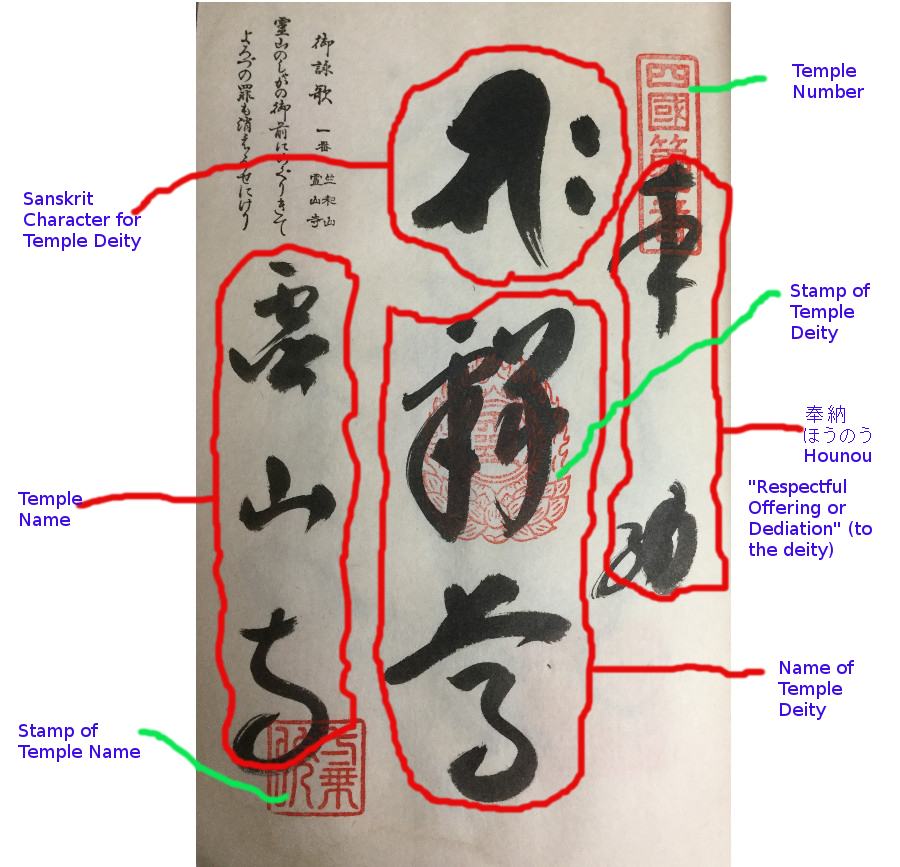
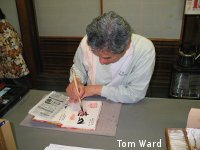
From the Daishidō, go to the Nōkyō Office (nōkyōsho) to get a stamp in your stamp book (nōkyōchō). The office should be open between 7am and 5pm.
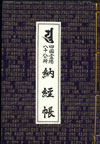 The stamp books are usually pretty elaborate, with some, like mine, having snippets of the Heart Sutra written on them in a gold color. The typical book is about 7" x 10" (17 cm x 25 cm) in size with one page set aside for each of the temples. There are no pages for the bangai temples, so if you are planning to visit those as well, you have two choices — buy another nōkyōchō specifically for the bangai temples, or take your book apart, add 20 more pages of similar paper, and put the book together again like i did.
A note about the stamp book: While almost all of us, nearly 100% i would assume, think that we are buying the stamp when we give the office the required ¥300 each time they put a new stamp in our book, that is really NOT the way we should look at it. All of us should take those thoughts out of our heads and simply throw them away. End of that story.
The way to look at the stamp fee is to remember that for some/many of the very remote temples, a large part of their annual income comes from donations. We, as henro, donate ¥300 to each temple we visit in appreciation of their significance as temples on and associated with the henro trail. We donate ¥300 to support their upkeep. Since no good deed should go unnoticed, in return for your donation the temple stamps your donation book to show that a donation has been made. We are not buying anything — we donate a trivial amount of money in appreciation for their efforts and they stamp your book in appreation of your donation.
That's the story we should have in our heads. To support that idea as you work your way around the island, my personal suggestion is to put your ¥300 in the tray for your money just after handing over your stamp book, but before they actually start writing. In other words, have your money out before you get there so you are giving your donation before they give you your stamp and you are not fishing around in your pack for the money while they are doing the writing. Make if really feel as if you are getting the stamp in appreciation for your money and not the other way around.
Besides getting a stamp in your book at each of the 88 main temples, there is also a stamp office on Mt. Kōya, on your right, just before the third and final foot bridge as you approach the Okunoin. Page one in most nōkyō books is set aside for that stamp so don't forget to get it before leaving for Shikoku. (The stamp just below on the left is that of Kōya-san's Okunoin in my nōkyō book. Click on it to see a larger version).
There is also a stamp office at each of the 20 bangai temples and a separate stamp book available at henro supply shops for those who want to collect these stamps as well. Like the stamp offices at the main temples, the offices are open between 7:00am and 5:00pm, every day.
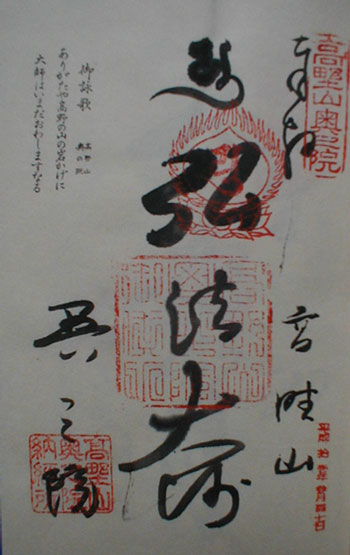 Here are two pages (external to this site) with pictures of all the temple stamps. The pages are in Japanese, but that shouldn't spoil the beauty of seeing each of the stamps — and they are beautiful. The 88 main temples and The 20 bangai temples.
{In case you are curious, here is a description of what is included in each stamp.}
[About the okunoin on Mt. Kōya. Even though all of the action takes place inside the okunoin, Daishi's mausoleum is located outside and around the back. Go out the side door on the left side of the building (as you are looking at it from the front) and head to the back of the temple. Once you get to the back, turn right towards the middle of the building. You can't miss it; there will be a lot of people and the air will be permeated with the smoke and sweet smell of incense. Also note (!!!), taking pictures and/or video is absolutely forbidden at the okunoin and the mausoleum. All filming must stop once you cross the third bridge, a few hundred meters before the okunoin. They used to have signs in English, but they only appear to be in Japanese now.]
Those are the only requirements and after completing them you are free to wander around and look at the temple buildings, visit with other henro, and enjoy the scenery. However, remember that until you walk back out through the main gate you are still on sacred ground. Only then are you back in the everyday secular world. As you leave, at the Sanmon turn around, face the temple, and bow in respect. If that is difficult, at least bow your head.
How many people do all of the above? I can't say, but i will say that i see people who do everything from none of the above to those who followed the requirements to the letter — and everything in between. Do what you are comfortable doing, but do as much as you can.
Not For The Faint of Heart
What's a henro to do? Well, there is a solution available. If you have ever spent any time watching Japanese TV drama shows that are set in the olden, samurai days, you've probably seen the scenes where the heroine needs exactly this type of help so she heads to the local temple to make her request. First she goes through the usual routine of making the request in front of the door, in sight of the altar, but then she heads back out into the yard.
After walking a short ways away from the front of the temple, she touches a stone marker, turns around and runs back to the temple, prays, runs back to the stone marker, touches it, runs back to the temple, prays, back to the marker, touches it, back to the temple,.... well, you get the idea. 100 times!!
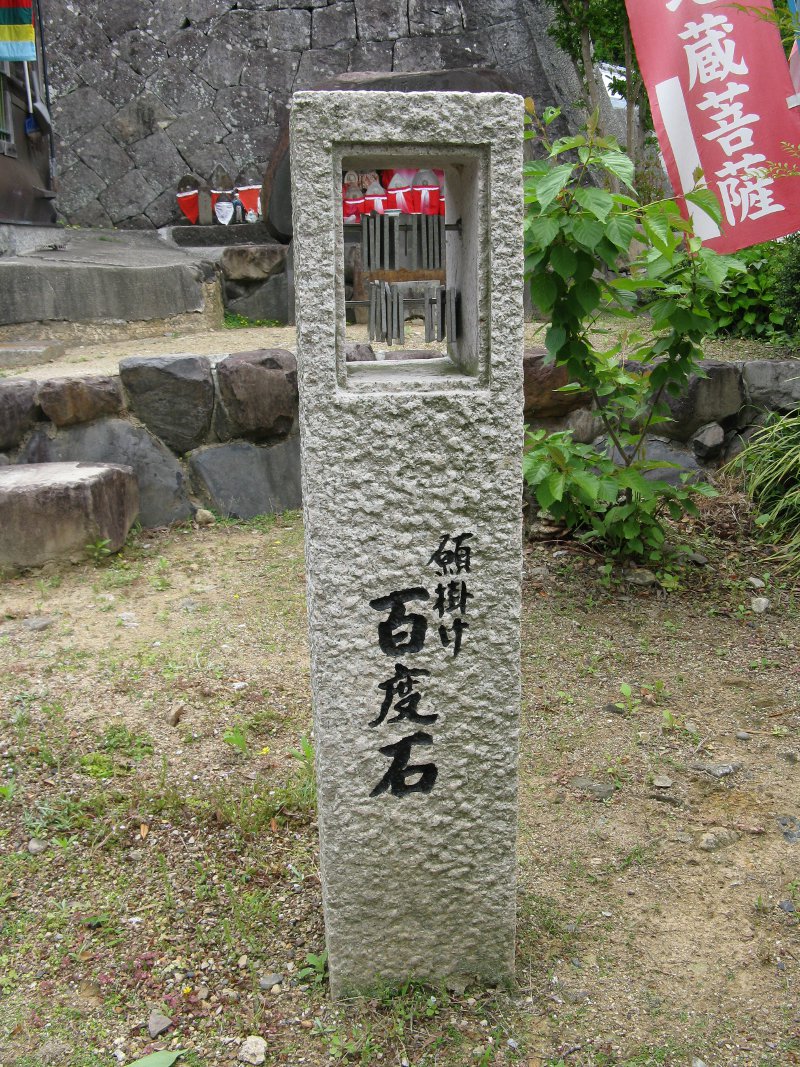
This is done 100 times, no more, no less. And for this reason, the stone markers are called "One Hundred Times Stones," Hyakudo Ishi. You can clearly see the kanji in the picture just below. They can still be found at most of the temples on the henro trail. I don't know if i should say "all" the temples because i have never gone out of my way to look for them, but certainly i would think it is fair to say "most" of the temples still have them.
|
They can be as fancy as this new(ish) one, with counters that give you the ability to keep track of what number you are on:
|
|
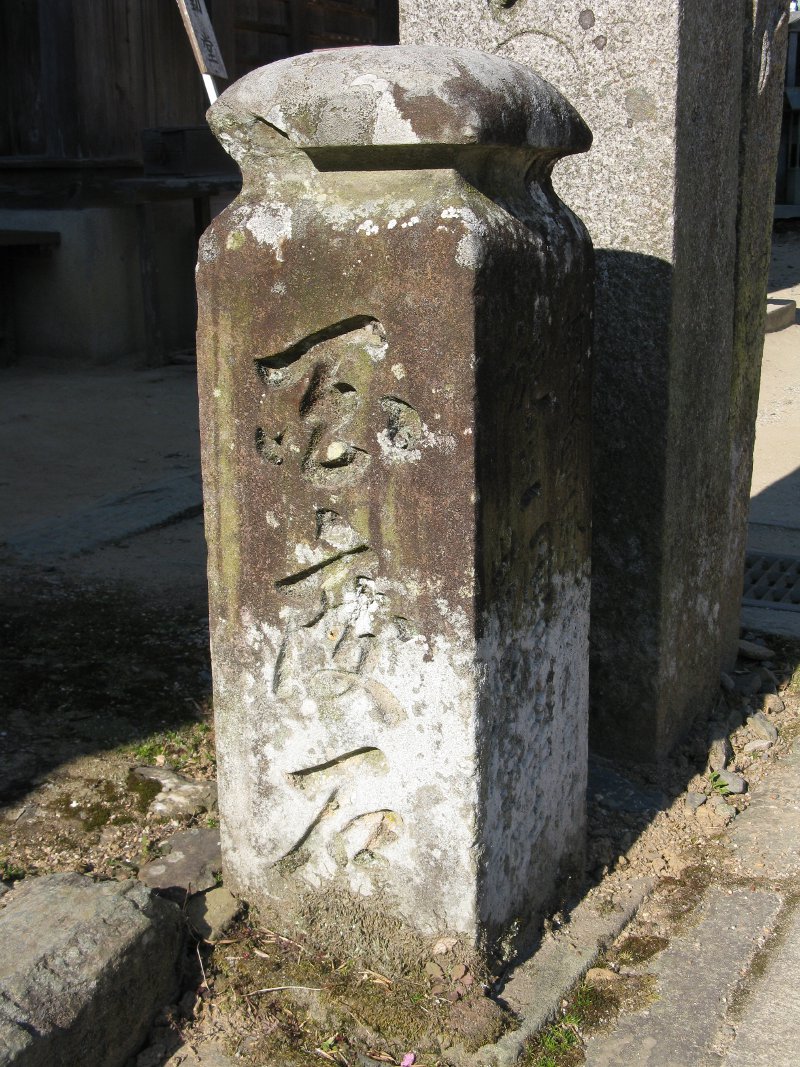
Or, they can be as small and old as this one:
|
|
So, keep these Hyakudo Ishi in mind if things aren't going well and you think you need help getting around the island. Don't try this in hiking boots, though, you'll do serious damage to your legs.
Thou Shalt Not, But Please Do
The fact that a henro should take, and vow to uphold, these ten precepts stems from the fact that the original henro were either Buddhist monks or laymen and women who adhered to the same principles. These ten vows are based on the Buddhist precepts and, in Japanese, are called the Jūzenkai. They are intended to keep you pure in mind, words, and action for the duration of your journey.