

{Shikoku Hachijūhachikasho Meguri}
--PLANNING--
--WHAT SHOULD YOU PACK?--
--PLANNING--
--WHAT SHOULD YOU PACK?--
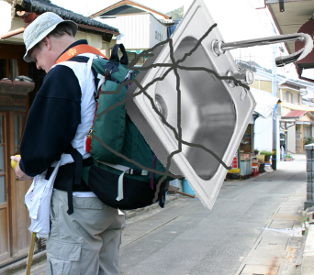
What, and how much, you take with you are both questions that can only be answered by each individual walker. Just remember that everything you take has to be carried on your back every day for up to two months. If you are staying in lodging every night, the vast majority of minshuku and ryokan have washing machines (occasionally, but not often, free for henro to use) so there is no reason to carry a lot of clothes. Therefore, you should opt to travel light.
In fact, the recommended procedure for trips like this is to:
In the end, you want to carry no more than somewhere between 10-15% of your body weight. Many people take more than they need because they don't really understand the word need, and end up regretting it later, only to either throw away the excess or pay to send it back home.
As an aside, as of December 2017 a new business has opened in Takamatsu, Kagawa Prefecture that specializes in renting bicycles. But, apropos this page, they also advertise that they offer baggage storage services to those who want to store extra suitcases while they are walking. More information can be found on their Facebook page.
Given all the above, below is what i take when i walk the henro trail. I take everything listed below, but items highlighted in this color are considered completely optional and your henro won't suffer if you don't take them.
| Clothes | Books | Other | First Aid |
|---|---|---|---|
| 2 pair of trousers | Shikoku Japan 88 Route Guide | Sunglasses | Bandaids |
| 1 long-sleeve shirt | Visiting The Sacred Sites of Kukai | Pen & Pencil | Adhesive tape |
| 2 short-sleeve shirts | Small notebook/memo book | Calligraphy brush | Aspirin (or similar) |
| 3 pair underwear | Copy of Heart Sutra | Small flashlight | Chapstick |
| 3 pair socks | Wristwatch | ||
| Belt | Compass | ||
| Boots | Swiss army knife | Camera | |
| Hat | Shaving kit | Camera | |
| Bandana | Electronics | Extra batteries | |
| J-E/E-J Dictionary | Battery charger | ||
| Fleece jacket or vest | Laptop/Tablet computer | Extra memory card | |
| Rain suit | Power supply | 6-inch screw-in tripod | |
| Folding umbrella |
Backpack
The smaller the better, because the smaller it is the lighter it is. But, i don't recommend buying something that just fits what you pack in it at home before even leaving for Shikoku. Once you start walking you will have maps, a nōkyōchō, incense, candles, food, drinks, and possibly other stuff that you may want to put inside in heavy rains. While you may not accumulate "stuff" as badly as i always seem to do, you do need a little room to grow and expand.
How small can you go? Some people on the Online Forum say that they have walked with packs as small as 28L! That's for the minimalist, though, and not for the majority of us.
To handle the rains you will encounter, in addition to a normal backpack cover, take a large heavy-duty garbage bag with you. Open it up and put it in your backpack. Then pack everything inside of the garbage bag. Look at it as a liner for your backpack. I don't care how good of a pack you buy, it is going to leak in some of the storms you walk through. I had a good pack and a good pack cover that i put over the outside of the pack when it rained, and the inside of my pack still got damp/wet in the first few heavy storms. That's when i got smart and started to use the garbage bag. If you don't take precautions, the contents of your pack are going to get wet — or at least damp. This includes things you don't want to get wet, like your camera and nōkyōchō. Pack everything in the plastic bag and fold the top closed before closing the pack, and then, with the pack cover on the outside, everything will stay nice and dry no matter how hard it rains.
Jacket/Sweater/Sweatshirt
I go back and forth between carrying a heavy sweater/sweatshirt or a fleece jacket. If i brought a cheap sweater or sweatshirt that i was willing to leave behind when i was through with it i could have discarded it when it started to warm up enough that it wasn't needed (somewhere in Kōchi Prefecture, if you walk clockwise) and not carried the extra weight for the next month and a half. Problem is, i like my light pull-over fleece jacket (the black one in the picture). If you are starting your walk in early March, stick with the fleece jacket. It can still be very, very cold in the mountains of Tokushima at that time of the year. If you tolerate the cold well, or ar starting in late March, go with the sweater or sweatshirt.
Rain Suit
If you walk in the spring, you will walk through some amazingly hard rains. I can't think of a time i have been there when i haven't walked through a storm that is compared to a typhoon. But, you have no choice but to walk so if you want to stay dry, you will need a good rain suit.
In 1999, i took a lamenated suit that didn't breathe. It kept the rain out, but as soon as i put it on i started to sweat, and walking in it was like walking in a sauna. If you happen to be climbing while it is raining, it gets worse. In 2006, i bought a new, breathable top from North Face and that did work out much better. But, in the end, i decided to spend the money for a much better (>$300) Mountain Hardwear hooded rain coat and finally found the solution. It breathes beautifully yet keeps the rain out in even the hardest of downpours. Below the coat i wear a pair of REI rain pants. The combination is perfect. In my opinion, for what it is worth, if you don't spend more than $250 on your rain coat, you will regret it.
But, ... if all you care about is cutting some weigh from your backpack, and you don't mind getting a little wet, you don't have to buy and carry a fancy "breathable" rain suit. These suits will keep you dry, but they also weigh a bit and are bulky. Instead, you could buy simple plastic poncho at Temple 1 when you buy your other henro supplies. (The picture in the link isn't a poncho, it's a jacket and pants, but the purpose of the link is to show you the type of material you can expect) It's called an amagu in Japanese and will probably cost less than ¥2,000. They are big enough to cover you and your backpack, but i don't think they have a hood to keep your head dry and they don't go down much past the knees so your legs will get wet. Disadvantage: you get wet below the knees. Advantage: It weighs nothing and takes up very little space in your backpack.
Clothes
As i said at the top of the page, with few exceptions all minshuku and ryokan will have a washing machine that henro can use to wash their clothes (occasionally free, but usually not). There is also a dryer sometimes, but they never work very well (IMO) so it is easier to dry everything on a line in your room. For this reason, i only take two pairs of trousers, two short-sleeve shirts, and one long-sleeve shirt for cooler mornings. I do take three changes of socks and underwear just in case i have to go a couple of days without seeing a washing machine.
For what it is worth, during my second walk i switched to socks that have a separate pocket for each toe. I happen to use Injinji brand, but there are probably other brands available. Once i made the switch to this type of sock, i have never had a blister since. I had one hot spot once, but put tape on it as soon as i felt it and the blister never developed. I removed the tape that night at the minshuku and it never came back. Make the switch! You'll thank me for it. (You'll be poorer, they're expensive, but you'll still thank me.)
You have to have a hat and a bandana. It gets hot on the trail and you'll fry if you don't. For the bandana, i'm talking about one of those big red, green, or blue ones about 50cm x 50cm (20" x 20") in size. It can be used to wipe sweat off your face, head, and arms; dipped in water and used as a wash cloth to remove dripped ice cream, dirt, or blood after a tumble; can be used as a substitute hat in case you lose the one you were wearing (i did recently and there's a picture on this site, somewhere, of me wearing my bandana as a hat); it can be used to cover your face and keep the sun out of your eyes while taking a nap on beach; it can be used to cover your face and keep the mosquitoes off while taking a nap in the mountains; it can be used to carry wet shells or pebbles that you found interesting until they are dry enough to transfer into your backpack; and the list could go on and on. I've used mine for all the above reasons and more and won't leave home on my bicycle or with my backpck without one. This is not really optional. :-)
Boots
As for boots, i wear high top hiking boots because i like the ankle support they provide, especially on the mountain trails. If this isn't a problem for you, i recommend simply getting the most comfortable shoes you can afford. Even though i always call this the Henro Trail, it is very rarely a real trail. Over 90% of the entire trip is walked on asphalt or cement, and by the 7th week of my first walk my feet really hurt. Surprisingly, my feet have never bothered me during subsequent walks, but in any case, i don't think this would have been an issue, or, at least, would have been less of an issue, if i had had a pair of very comfortable shoes made for walking on asphalt roads day in and day out. Buy the most comfortable shoes you can afford. This is not the place to try and save money. If you can, get a pair that is waterproof and that provides excellent arch support.
Electronics
Electricity on Shikoku, like in the rest of Western Japan, is 100 volts and 60 cycles. In addition, the plugs and wall receptacles are the same standard polarized blades as used in the United States. That means if you are coming from the US, you do not need any special plugs or adapters to run your computer or other electrical equipment. If you are coming from a country that is different, you'll need to bring the necessary adapters and transformers. Be aware, though, that 3-prong receptacles are almost unheard of in Japan. All you will see are the 2-prong blade type receptacles. If your plug has three prongs, you will need to bring a plug adaptor.
Maps & Temple Information
You'll need maps to get around the island. There are both Japanese and English versions now available and these are listed on the Books page of this site. If you want historical information on the temples themselves, then carry one of the two guidebooks available with this information (both are in English). One was wrtten by Tatsuo Muro and translated into English by David Moreton, the other was written by Taisen Miyata. As i said, this is historical information, so you don't really need to carry it when you walk. I carried it the first time around the trail, but not the second. Actually, i don't recommend taking it, it is just extra weight. Buy it before leaving, read it at home, and then leave it there.
Notebook, Pen, & Pencil
In 1999 i took a small notebook and pen/pencil to make a note of every picture i took so i wouldn't forget what it was when i got back home. I found, though, that it's easy to remember the temples without doing this. Every time you get to a different temple, the first shot should be of the sign out front with the temple's name and number. You then know all the following pictures are of that temple until a new sign appears. For shots of scenery, people, etc., you'll still want the notebook — or a much better memory than i have.
Shaving Kit/Personl Hygiene
If you are staying in lodging every night you don't need to carry much in this category; all minshuku, ryokan, and hotels provide soap and shampoo for free. Hotels even give you a toothbrush and toothpaste for free, but not the minshuku and ryokan. All i carry with me is shaving cream, a razor, toothpaste, tooth brush, fingernail clippers, and a hair brush. I also carry a very small bar of soap to use as both soap and shampoo in case i get somewhere and they don't have either (which has never happened).
If you're a woman, this list will probably change. If you're camping out every night, you'll have to carry more.
First Aid
I carry aspirin because that is the only medicine i ever use. I don't use Tylenol, Ibuprophen, or any of those other pills. I always carry aspirin, though, and take it if i get sunburnt, i have a blister(s) that are hurting, my shoulders are sore, i don't feel well, etc. For me, aspirin is the universal pain reliver and i typically take a couple once every week or two. I'd have to be really sick to take it more often than that, but i always carry some. If you have a different drug of choice, carry that instead. I do think you'll want to carry some type of pain relief.
You must carry both adhesive tape and bandaids. Almost everyone gets blisters, and you need these to take care of them. See the Preparation/Training & Your Feet page for more information on what to do when you get blisters.
I thought everyone in the world knew what Chapstick was, but received an email from a European who said he had no idea. Chapstick is a brand name, but is frequently used here in the US as a generic term for a lip balm. In short, it keeps your lips from drying out and cracking. For me this is not an optional item, but for many of you it may be. (Another popular brand here in the US is Blistex.)
Optional Items
• I took a flannel shirt in 1999 just to have it for chilly mornings and evenings while sitting around the minshuku. It doesn't weigh anything, so saw no harm. In the end, though, i almost always now live in the yukata that is provided by the minshukus and ryokan, and didn't take the shirt at all during my second walk. Nice if you don't wear the yukata, but not needed if you do.
• There are times when one of those small fold-up umbrellas really makes the rain less of a bother. Especially when it is only sprinkling and it doesn't look like it will last long. Pulling out the umbrella is always much easier than putting on rain gear, only to have to take it off a half-hour later. However, this is completely optional since you'll be carrying full rain gear anyway.
• It is rare, but i still occasionally see people carrying a loptop computer. If you do, be sure to take the power supply. If you don't, you don't need the power supply; obviously.
• In 1999, i wrote the Heart Sutra each night at the minshuku or ryokan and left it at the temples the next day. That's why i took a calligraphy brush. During my second walk, i didn't do this, so didn't carry the brush.
• I never once used the compass. Didn't even take it out of my backpack. It is just not needed. Period. The trail is very well marked. If you get lost, ask someone to point you in the right direction. Walk a half-kilometer and ask again. You can do this as long as you want and sooner or later, you'll figure out where you are. The guidebooks for walking henro are very detailed and a lot of people are familiar with them so feel free to show it to them. I was surprised at the number of people who would ask to see it and then, after turning it this way and that, figure out where i was and how to send me in the direction that i wanted to go. (Having said this, however, i received an email from one henro who says that he took a compass and used it all the time — although he admitted still getting lost.)
• I left the swiss army knife on the list simply because i carried it my first time around the island. Because i carry my backpack as carry-on luggage when i travel, i can no longer get past security with it, so i have not carried this during any subsequent walk. If you are camping out, it may be useful, but if you are staying in minshuku and ryōkan, leave it at home — you'll never use it.
• Almost everyone will take a camera with them when they go. That means you should probably carry extra batteries. I don't list these as optional. However, since i stay in lodging every night, and have access to electricity, i also take a battery charger just in case. One year i didn't take extra batteries and thought i'd buy cheap batteries at a convenience store. I did, and the batteries died after about 30 pictures so i always take extra rechargable batteries from home now. I also take an extra 8GB memory card. If you take a lot of pictures this may or may not be optional. My little tripod isn't used very often, but on rare occasions i do use it to include myself in a picture. It is certainly optional, but since it weighs nothing, it doesn't hurt to throw it in a pocket of your backpack. The card reader (or camera-to-pc cable) is only necessary if you carry a loptop/netbook/tablet with you and want to review your pictures on that device each night.
Advice: Take It Or Leave It
 Several people have asked me if it is OK to wear shorts during the pilgrimage and that is always a difficult question to answer. Are shorts forbidden? No. Is it traditionally unacceptable? No. One of the things about this pilgrimage that separates it from others is that anything is OK. Any type of dress, any mode of transportaion, any level of participation. There is no right or wrong, only more or less traditional. By those standards shorts should be perfectly acceptable.
Having said that, though, in Japan adults don't usually wear shorts in public unless they are participating in a sport that requires it. Completely apart from pilgrimage tradition, Japanese tradition is that adults don't wear shorts. This is especially true in the more rural, and hence traditional, areas — like on Shikoku. Since i am a believer in Gō ni itte wa, Gō ni shitagae (When in Rome, do as the Romans do), i opt not to wear shorts when i am in Japan even though i live in them here in the US. That is, of course, only my personal opinion and should be taken as such. Each henro needs to make their own choice.
Having said all that, when i was on the trail in 2016, for the first time i saw two or three men walking in shorts. In addition, i noticed several men walking in shorts, but wearing ankle-length black tights underneath them. While it's not a fashion style i'll be emulating anytime soon, it could be comfortable and reasonably cool. Plus, i never heard anyone say anything about any of the people in shorts or shorts+tights, and never saw anyone look at them crossways when they met another henro. So, tradition must be changing, albeit slowly.
Thanks to Jan-Willem Paijens for his input and help in revising and improving this page.