{Shikoku Hachijūhachikasho Meguri}
--BOOKS & PAPERS ABOUT THE PILGRIMAGE--
--BOOKS & PAPERS ABOUT THE PILGRIMAGE--
General Shikoku Pilgrimage Information:
Books:
While i haven't read the book yet, according to Susan, "Takamure intended to make a solitary pilgrimage but met an old man of 73 who insisted on accompanying her as her servant and guardian because he believed she was an attendant of Kannon Bosatsu. En route, she was sometimes regarded as a deity and asked to cure diseases, she met various outcasts of Japanese society, she endured typhoons and tremendous heat. Takamure tells her story in a very emotional manner and it is very readable."
Self-Published
Available on Amazon and Amazon Japan
2010
Guidebooks:
Either this book, Journey of The Soul immediately below, or Visiting The Sacred Sites of Kūkai further down the page is a definite should read, and maybe one of the books you might carry with you in order to read the historical information about each temple as you visit it.
Either this book, A Henro Pilgrimage Guide to the 88 Temples of Shikoku Island immediately above, or Visiting The Sacred Sites of Kūkai further down the page is a definite should read, and maybe one of the books you might carry with you in order to read the historical information about each temple as you visit it.
Because this book was designed for people who drive their car, this might be a great option for bicycle henro.
Volume two of Shikoku Henro Hitori Aruki Dōgyō Ninin is the map book that leads you from temple to temple and around the island. It contains all the necessary maps needed to make the trip and at least this volume is invaluable to all walkers of the pilgrimage. Even though all the writing is in Japanese, this shouldn't be a problem once you take the time to figure out how it is laid out - a time consuming but easy task. I offer some advice on this process on other pages in this web site. Volume two also contains about a dozen pages with the names, addresses, and phone numbers of minshuku, ryokan, hotels, and other places to stay. It is a great reference and all you probably need.
You can buy the books at several temples or (possibly) online at the Henro Michi Hozon Kyoryoku Kai website. The current 11th edition of the maps costs ¥2,915, or ¥4,080 for set of two books. The website says they are available at Temples 1, 10, 21, 23, 24, 37, 40, 45, 51, 54, and 75. Plus, several other shops listed.
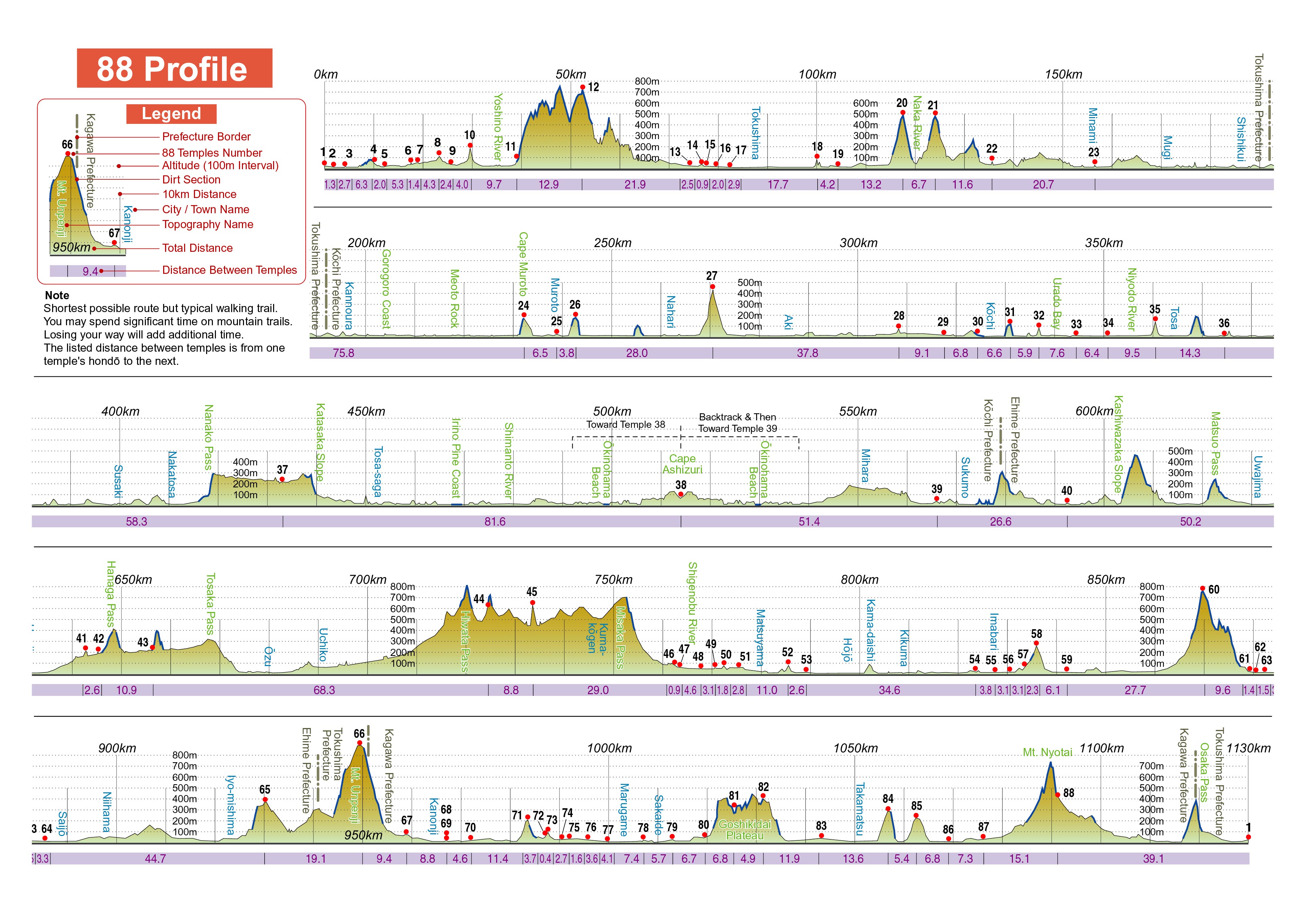
The book includes 45 pages of general (but helpful) information about the pilgrimage plus all the maps you need to get around the island, including the main 88 temples, the 20 bangai temples, Mt.Ishizuchi, and Mt. Kōya. The maps also indicate lodging, grocery stores, convenience stores, restaurants, gas stations, rest areas, public toilets, and much, much more. All temple descriptions include how to get there via public transportation, and where it may be benefical, some bus timetables are included. The guidebook also contains an elevation profile, beginning at the front of the book and continuing on the bottom of two of the individual map pages.
An excellent book and i both use it and highly recommend it.
Note 1: This is an excellent guidebook, but over time, occasional mistakes do appear as some lodgings close and others open, phone numbers change, etc. When i hear about these, i post the information on the Online Forum, in the section titled, appropriately, Shikoku Japan 88 Route Guide. With each new edition of the book, the publisher also includes a list of recent lodging closings and changes. This is also posted on the Online Forum. If you find something closed and out of business, but still listed in the guidebook, please help all other henro by posting it to the forum or emailing me and i will do it.
Be sure to check the forum for any recent closings/changes and update your copy of the guidebook before heading to Shikoku.
Note 2: A Korean version is also available. Follow the link below to Buyodo Publishing if you're interested.
The guidebook is available the following online sites:
The guidebook is also available at these physical loctaions:
This book is divided into two parts: the first half gives general information on the pilgrimage: how much it cost, when to go, what to pack, etc. The second half gives a paragraph of historical information on 238 temples found along the henro trail.
From the Amazon.co.jp website: "Originally published in Japanese, this renowned guidebook by Tateki Miyazaki offers detailed and practical information on how to make the 1,200-kilometer pilgrimage around the island of Shikoku. For example: when is the best time to go, how much does it cost, how to make a daily plan, what to take, what to do at each temple, what rules a pilgrim should follow, how to sleep outside, how to perform takuhatsu and waterfall training, and what to do when the journey is over. In addition, in the second half of the book, there are brief historical descriptions of 238 sacred sites along the pilgrimage route that have some relation to the 8th Century Shingon Buddhist priest Kūkai, who is also known as Kobo Daishi."
Either this book, A Henro Pilgrimage Guide to the 88 Temples of Shikoku Island (above), or Journey of The Soul (above) is a definite should read, and maybe one of the books you might carry with you in order to read the historical information about each temple as you visit it.
Note: A 2nd printing of Sacred Sites was released in September 2015 that adjusts page number references to match the new 4th edition of 88 Route Guide. The content hasn't changed — just page numbers and typos were corrected. I still have copies of the 2011 1st printing and will sell them for $5.00 + shipping (about $6 less than the total price below). Email me if you want one.
PART 1 (57 pages)
PART 2 (87 pages)
Biographical Information about Kūkai/Kōbō Daishi:
Religious Foundations & General Japanese Buddhism:
The Heart Sutra:
Bishop Taisen MIYATA
Los Angeles Kōya-san Buddhist Temple
342 First Street
Los Angeles, Ca, 90012
(I bought it from Bishop Miyata at this address way back in 1999, so i don't know if it is still available there...)
[Miyata's A Henro Pilgrimage Guide (above) and Moreton's A Journey of the Soul (below) are very hard to find now. You're best bet might be to get a copy of Visiting The Sacred Sites of Kūkai. While not the exact same information it is close and is still highly recommended.]
Tatsuo MURO and David MORETON
Moreton's web site.
[Miyata's A Henro Pilgrimage Guide and Moreton's A Journey of the Soul are very hard to find now. You're best bet might be to get a copy of Visiting The Sacred Sites of Kūkai. While not the exact same information it is close and is still highly recommended.]
The Office of AWA88
Nakatori-machi 2-32
Tokushima-ken, 770, Japan
Available online
Zasshi Shikoku
Nariai-machi 772-7
Takamatsu-shi
Kagawa-ken
Yubin Bango 761-8082
Japan
(087) 885-1939
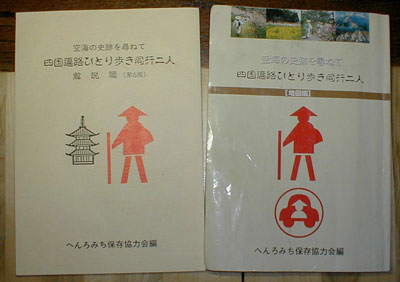
Volume 1 on the left. Volume 2 (maps) on the right.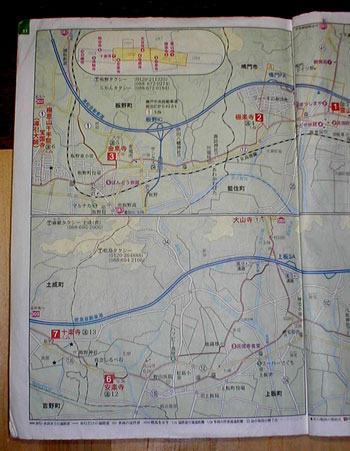
An example of one of the pages in the mapbook.
There website is at www.iyohenro.jp (Japanese), although i'm not sure they ship internationally.
The true Henro Bible for all non-Japanese speakers. Everything you need to know, and every walking henro who doesn't read Japanese should to carry it.
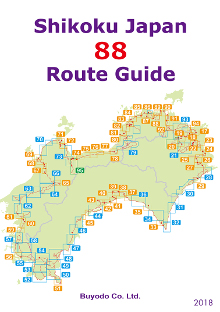
Guidebook Cover
(6th Edition; 2018)
Table of Contents
Contents: 1
Legend: 2
Index Map: 3–6
Elevation & distance map No. 1: 7
Kōbō Daishi (Kūkai): 8
Useful Information: 8–10
Proper etiquette at a temple: 11
Oaths and Precepts: 12
Basic Information of Buddhist Statues: 12–13
Pilgrim Attire and other items: 14
Access: 15–16
Maps: 17–95
Elevation & distance map No. 2: 75–76
Going to Mt. Kōya: Map 95
Practical Phrases: 96
List of Public Information Offices: 97
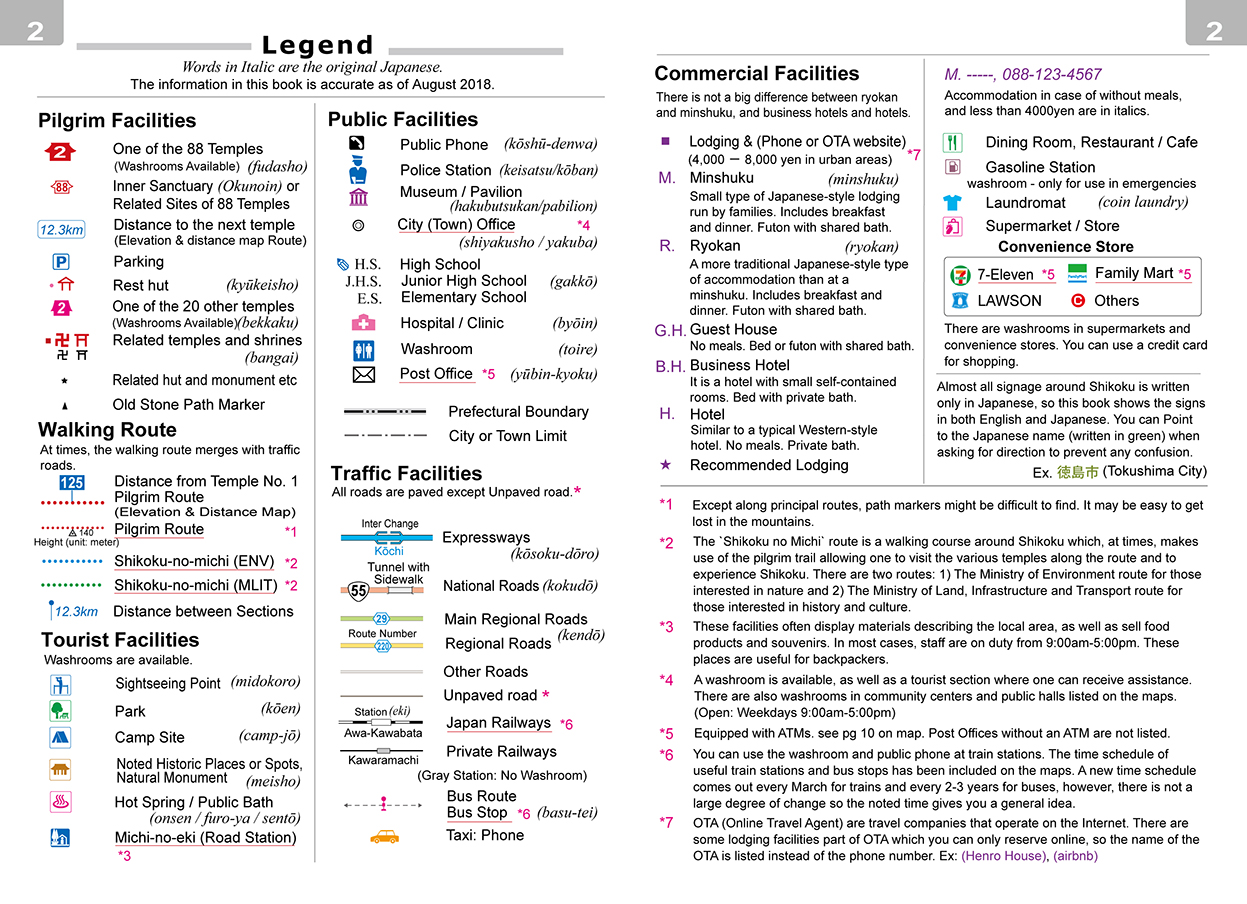
Guidebook Legend
(Click to enlarge)
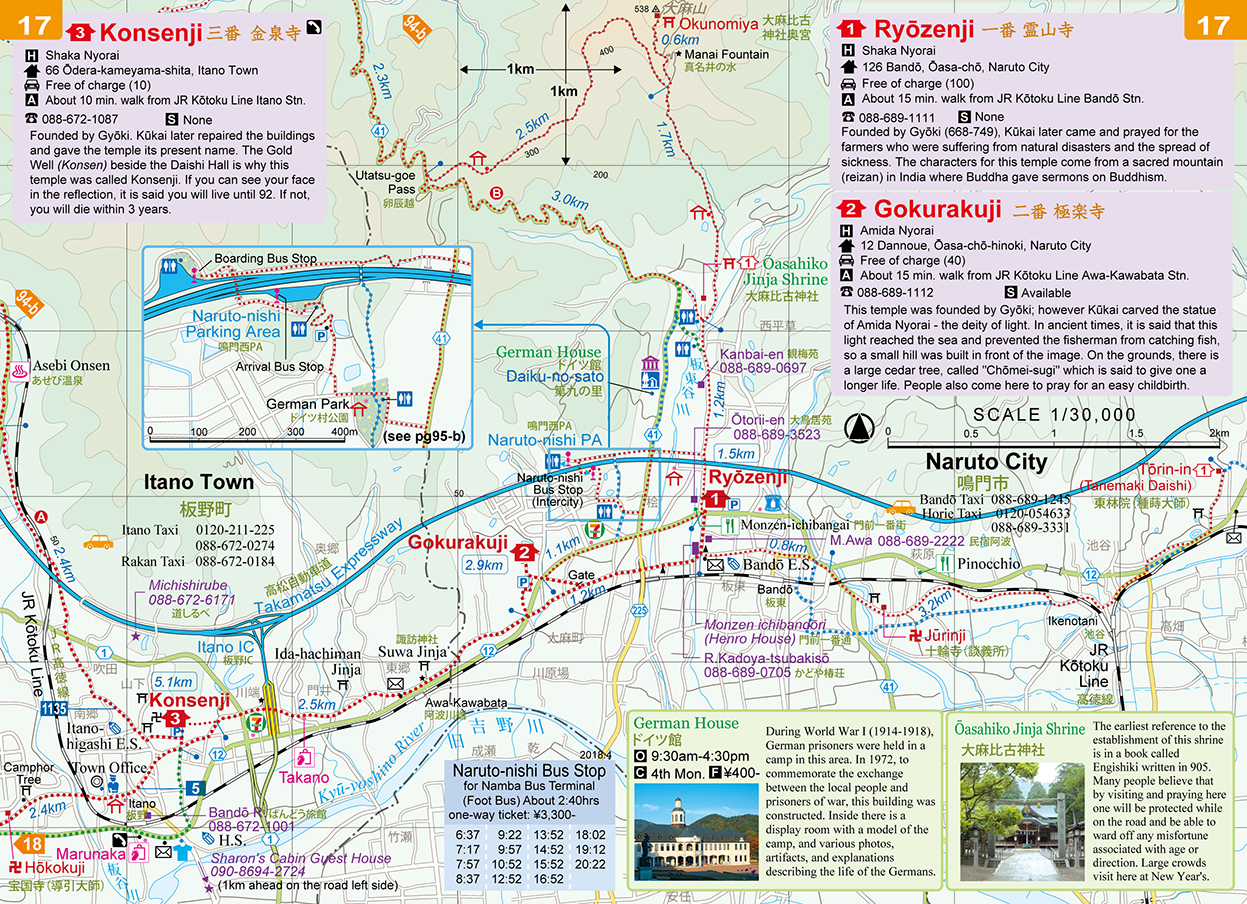
Example map page
(Click to enlarge)
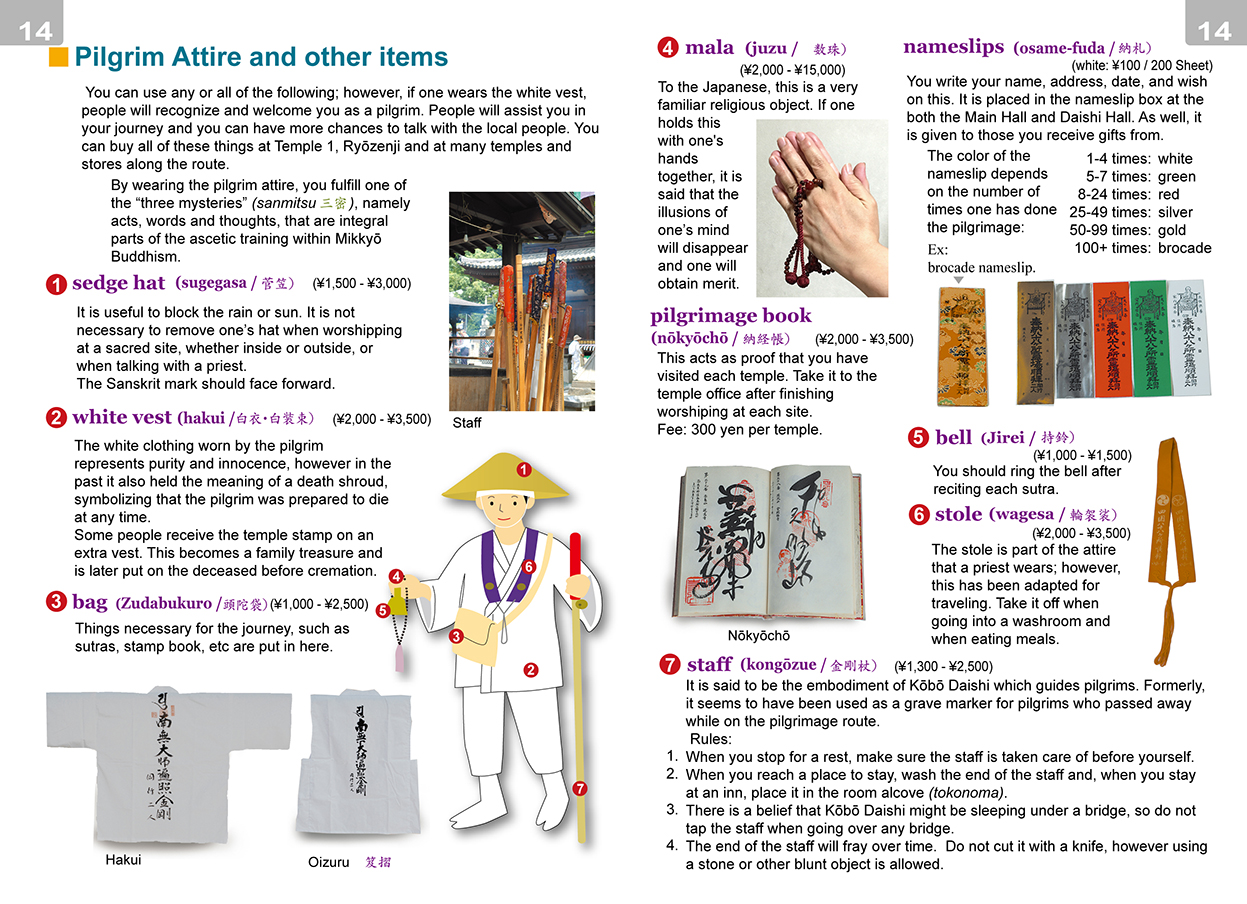
Example page
(Click to enlarge)
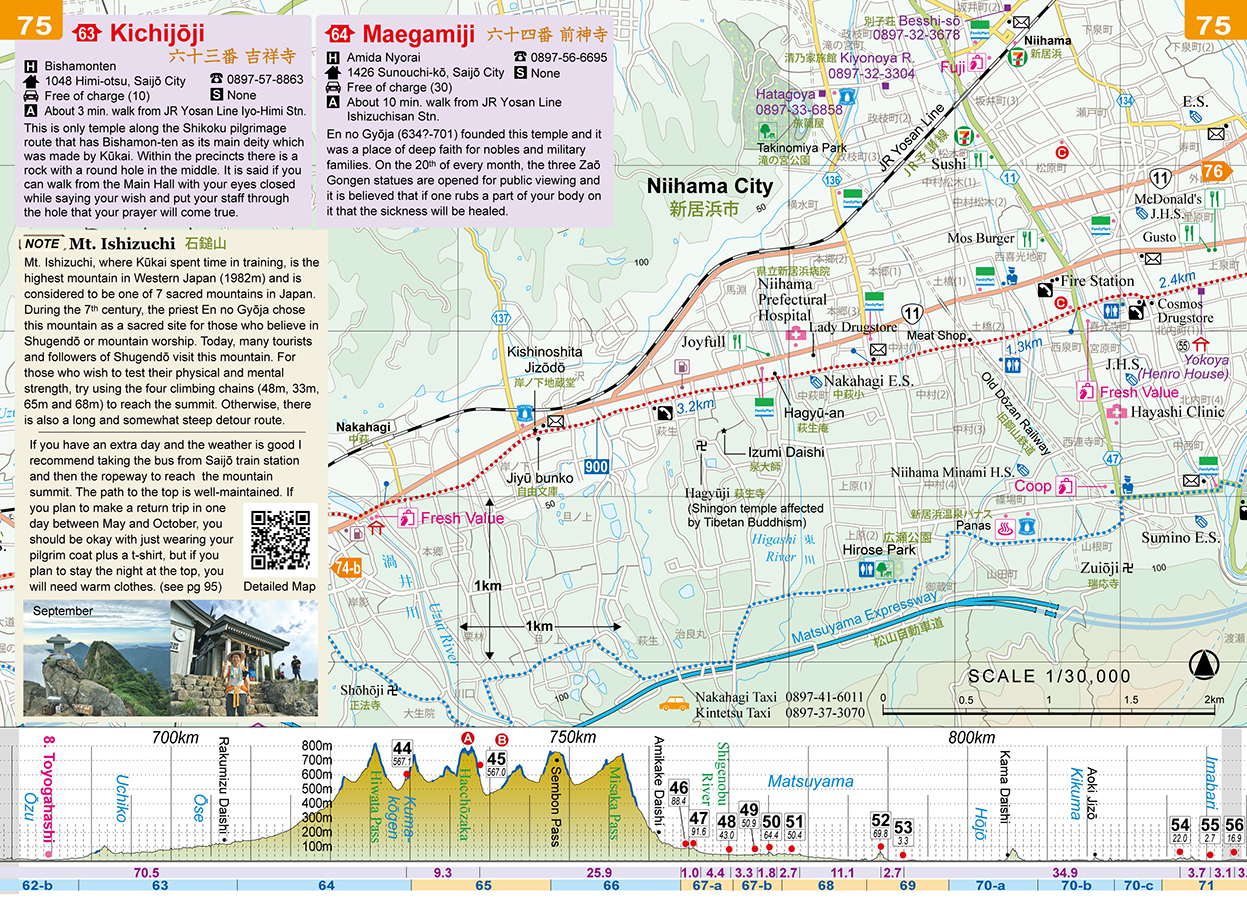
Example elevation map
(Click to enlarge)
Shikoku Japan 88 Route Guide
Online Site
Ships From
Buyodo Publishing
(The author/editor/publisher's personal website)
(Look for the "Method of ordering and payment" section of the page)
Japan
Amazon Japan
Japan
Outside of Japan:
A translation into English of the first volume (no maps) of the Japanese guidebook by Miyazaki Tateki, Shikoku Henro: Hitori Aruki Dogyo Ninin (Shikoku Pilgrim: Walking Alone, Two Fellow Pilgrims) [See above].
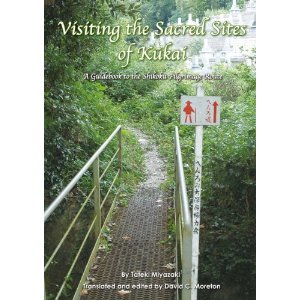
Table of Contents:
Chapter 1: Time
Chapter 2: Number Of Days Required
Chapter 3: Preparing For The Trip
Chapter 4: Costs and A Budget
Chapter 5: How To Plan
Chapter 6: Pilgrimage Goods and Things To Pay Attention To
Chapter 7: Equipment and Things To Carry
Chapter 8: The Weight Of The Gear
Chapter 9: Pre-Departure Preparations
Chapter 10: Money
Chapter 11: Making Reservations
Chapter 12: Manners At The Sacred Sites
Chapter 13: Rules (Do's and Don'ts) Of A Pilgrim
Chapter 14: How To Walk The Pilgrim Path
Chapter 15: Sleeping Outside
Chapter 16: About Takuhatsu
Chapter 17: Waterfall Training
Chapter 18: Going Home — The End Of The Training
Appendix 1: Chart Of Time/Distance Between Temples
Appendix 2: Weight Of Basic, Commonly Carried, Gear
List of Sacred Sites
The book is available at the following online sites:
Visiting the Sacred Sites of Kūkai
Online Site
Ships From
Buyodo Publishing
(The author/editor/publisher's personal website)
(Look for the "Method of ordering and payment" section of the page)
Japan
Amazon Japan (Paper version)
Amazon US (Kindle version)Japan
Weatherhill, 1995
UMI Dissertation Services, 1999
UMI Dissertation Services, 1951
Columbia University Press, 1972
ICG Muse, Inc, 2003
Japanese Journal of Religious Studies, 1995
Vol. 22/1-2
Columbia University Press, 1958
White Pine Press, 1987
Online Document
Columbia University Press, 1999
Houghton, Mifflin & Co., 1884
Buddhist Books International, 1978
University of Hawai'i Press, 1999
Princeton University Press, 1960
Princeton University Press, 1987
Columbia University Press, 1966
Princeton University Press, 1999
Kosei Publishing Co., 1994
Shingon Buddhist International Institute, 1988
Buddhist Books International, 1978
Japanese Journal of Religious Studies
1996
Vol. 23/3-4
International Academy of Indian Culture and
Aditya Prakashan, 1997
The Heart Sutra is (no pun intended) the heart of this pilgrimage. It is chanted by virtually every henro at both the Daishdō and the Hondō of every temple. The deeper our understanding of it's intent and meaning, the deeper our potential realization while on the trail. Here are some of the books that try to make sense of it.
Trafford Publishing, 2007
Penguin Books, 1959
Vintage Books
Vintage Spiritual Classics, 2001 Reprint
Princeton University Press, 1996
Wisdom Publications, 2002
Tharpa Publications, 1996
Charles Tuttle Company, 1988
Nakayama Shobō, 1988
Kōsen NISHIYAMA, Translater
Shambhala Publications, 1988
Great Ocean Publishers, 1975
Shambhala Publications, 1997
Wisdom Publications, 2005
Buddhist Text Translation Society, 2003
Parallax Press, 1988
Shoemaker & Hoard, 2004
Snow Lion Publications, 2003
Element Books, 1994
State University of New York Press, 1988
Viking Studio Books, 2000
Columbia University Press, 1972
Dharma Drum Publications, 2001
Grove Press, 1974
Smashwords Publishing, 2010
Shambhala Books, 1996
 | Walking With Kukai: A Pilgrimage In Japan.. A video about the henro michi available at the Dutch Buddhist Broadcast Foundation website. From the website: "Documentary about the Kukai Pilgrimage. Each year, tens of thousands of people follow the route plotted out by the buddhist monk Kukai centuries ago. By car, by foot, in a bus or on a bicycle. Despite heat, wind, rain and exhaust fumes. What keeps them going? We meet the modern Pilgrim." |
 | ARUKIHENRO: Walking Pilgrims in Shikoku, Japan. Devout hikers or adventurers on a quest for themselves? Tommi Mendel spent 9 months on the henro trail interviewing walking henro and has produced this ethnographic documentary film about the pilgrimage. The film has ben screened at several international ethnographic film festivals around the world. It highlights the reasons and motivations of today's walking pilgrims, as well as their quest for personal change along the 88 Temples' Pilgrimage. Available for purchase at his web site. Tiger Toda Productions. |
 | 88 — pilgrimage in japanese Gerald Koll put together this film documenting his trip aroung the henro trail in 2008. I'll let him describe how it came about: "I am not a spiritual person. I don't believe in metaphysical things very much. Neither on the Spanish Camino nor in the Japanese pilgrimage. But I am interested in this kind of culture and the people. So I have a distance. A distance to myself too. Many documentaries present the nice parts of pilgrimages. Many documentaries present the beautiful sights of Japan. There are enough of this kind of movies. I was annoyed by the typical drama in three steps of "expectation," "suffering," and "happy ending." In 88 — pilgrimage in japanese I tried to find a different way: I tried to be honest; honest with my feelings and with myself in the double-role as a pilgrim and as medium. I wanted to be penetrated by the culture and the spirits. I wanted to be helpless. I wanted to be alone to cross the boundaries to the Japanese people, the pilgrims, the state of mind of a pilgrim. So I decided to do this pilgrimage on my own. Without anybody, without cameraman, assistant or whatever. It was worth it. I wanted to sink in foreigness. And I did." Available for purchace at Gerald's web site. |